
Why I Write Down Every Trade: The Trading Journal Habit
Marc Chow on his US stock trading journal: the spreadsheet that became data entry, why he stopped using it, what he records now, and the pattern his own records keep showing him.
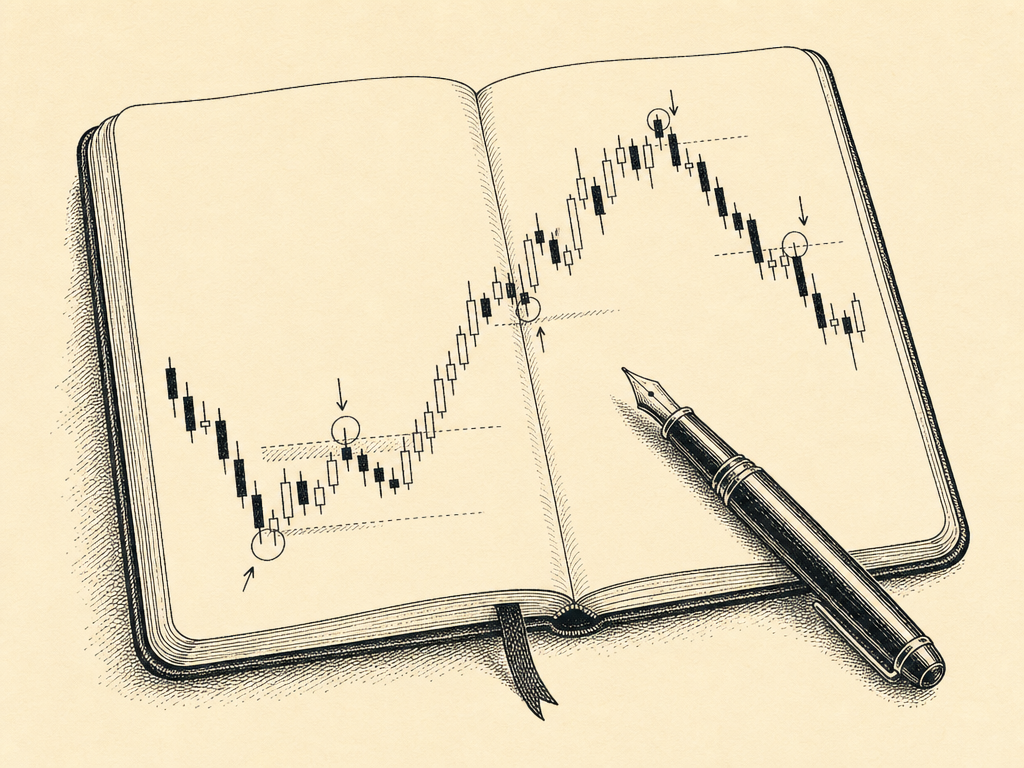
I write down the exit before I take the trade, and afterwards I write down whether I actually followed it. That is the habit now. Getting there took a spreadsheet I no longer use, two years of more data entry than trading, and a deliberate decision to trade less. Memory is a generous historian; a written record is not.
Key Takeaways
- The habit is the written exit, not the software behind it.
- A proven tool can still fail you by costing more time than the trades are worth.
- When the win rate stopped being a must-have, the automated scoring stopped earning its keep.
- A losing trade followed to the letter is a good trade. A winning trade that broke the plan is a problem.
- Patterns are invisible in memory and loud in a record.
- The template is eleven fixed fields, written the same way every time.
- A record nobody else can read is a claim, not a track record. Publishing the entries is the part that counts.
The spreadsheet years
For my first two trading years I logged everything into a spreadsheet template I had bought from a spreadsheet guru on ETSY. It was complex and it worked. I entered the transaction details and it produced the statistics for me — cost, gain, loss and win rate on a weekly, monthly and yearly basis, without me building a single formula.
In many of those months I was taking 100 to 200 transactions a week. Here is what nobody tells you about that: manual data entry is tedious, and the template could not batch import my records. I was spending more time typing trades than I was spending time looking for them. The tool was proven and the outcome was still a bottleneck, because the bottleneck was me, one row at a time.
Why I stopped using it
As my trading matured, the picture changed. I had developed a set of trades I could win sustainably, and once that was true, a quantified win rate stopped being a must-have and became a good-to-have. I was paying a heavy price in evenings to measure something I already had a feel for.
So I quit the spreadsheet, and I cut my trading volume down to tens of transactions a month. I still gain from it. What I gained alongside it was time — enough to learn AI for fun, and enough to build, soon, an AI tool that tracks my portfolio performance for me.
That tool is not built yet, and the reason is worth stating plainly: Charles Schwab does not give retail traders like me API access. I have to download my trading records by hand and feed them into whatever analytic tool I want to use. Not fun. Until that is solved, my record stays light.
What I record now
The heavy version is gone. What survives is the part that was always the point: the exit written down before entry — the last of my five entry checks — and afterwards one honest sentence about whether the plan was followed.
I used to close every entry with the result in R — profit or loss measured against the initial risk — because the spreadsheet scored it for me. I do not score it now. The sentence does the work instead, and it is harder to write than any number.
A losing trade followed to the letter is a good trade. A winning trade that broke the plan is a problem — the market paid me for a mistake, and it will charge for it later. Without a record, those two outcomes look identical in memory: one trade went up, one went down, and I felt fine about both.
The template I record every trade in
The light version still has to be a fixed shape, or it is just a diary. Every trade gets one row, filled in the same eleven fields, in this order, at the moment I take it — not afterwards, when the outcome already knows what the reason is going to be.
| # | Field | What goes in it |
|---|---|---|
| 1 | Date taken | The calendar date of the entry, not the date I got round to writing it. |
| 2 | Ticker | The symbol I bought. |
| 3 | Setup | The signal that put it on the list, named from my own five entry checks — not “looked good”. |
| 4 | Entry price | The fill, with the share count. |
| 5 | Position size | The dollar amount risked, stated as the distance from entry to stop. |
| 6 | Stop / invalidation | The price at which the idea is wrong, written before entry. This is the column I refuse to leave blank. |
| 7 | Planned exit | The target, and the condition that would make me hold past it. |
| 8 | Actual exit price | What I really got. |
| 9 | Date exited | When the position actually closed. |
| 10 | Result | Gain or loss, plainly, no adjustment. |
| 11 | Why, and did I follow it | One sentence for each: the reason the trade was taken, and whether the plan in fields 3 to 7 survived contact with the market. |
Field 11 is the whole template. A writer can publish fields 1 to 10 for any strategy on earth, because a broker can supply most of them. What a reader cannot get anywhere else is the reason and the follow-through, and those are the two things a blogger has the most reason to leave out. Filling in field 11 while the trade is still open, in one sentence, before the result exists — that is the part that keeps the record honest. It is also the part that is most annoying to write, which is a reasonable proxy for whether it is worth anything.
Why the record has to be published
A journal kept in a drawer is a private discipline. A journal you publish is an audit. The difference is the entire point, and it is why this is not busywork for its own sake.
A trading blog fails in one specific way. The claims — that a method works, that the author is disciplined, that the drawdowns were survived — are not checkable by reading, because any sentence can be written around any result. Win rate can be quoted from the best month. A screenshot can be cropped to the winning months. “My process is rigorous” is unfalsifiable until somebody is handed the rows and can count the trades that broke their own plan.
So the rule on this site is the rule I would want applied to me: if the record is not published, the performance claim is not made. The template above is offered in full, the same one, unfilled, because a template you do not publish is a claim that a template exists. Take it, use it, keep it however you like. If your own records cannot survive being read by a stranger, that is information, and it arrives before the money does.
What I intend to publish here
The goal for this site is a monthly journal update, generated from a JSON export of my own transaction records, in a fixed format, so the figures are produced by a rule and not by my memory on a quiet Sunday. Two design points, both deliberate.
The published figures will lag the present by about a quarter, roughly the pace a 13F filing reports. That is the point of the delay. A journal updated same-day can be reverse-engineered into whatever story the last few weeks support, and a blogger who sees the number before you do has a permanent structural advantage over the reader. A quarter of lag removes it. You are reading what was true a quarter ago, not what I want it to look like today.
The honest blocker is still the one above, and it is not a small one: Charles Schwab does not offer API access to retail traders, so the records still have to be downloaded by hand, one export at a time, and reconciled by hand. That is what stopped the automated scoring in the first place and it is still what stops the pipeline. I am considering running a separate portfolio for this purpose — at Schwab, or at IBKR, where API access is reportedly easier to get — so that the published record is generated rather than typed.
Until that pipeline exists the journal stays what it is today: kept, private, and mine. I am not going to put a number on this page before there is a machine behind it, and I am not going to promise a date for the first monthly update. When the export exists, it gets published, and the first post is the one that shows the worst month in the file, not the best.
The pattern my own records show
The habit of writing things down at decision time matters for a plain reason: memory will later insist every trade was taken for good reasons, and the record is the only thing that disputes it.
Over time one pattern of mine shows up repeatedly. Quite often I need to exit a position that has not matured on the continuation signal — before it reaches the Bollinger Band 2 sigma — because I need the liquidity free to capture another trend I can already see coming. Reading that record in a column made it obvious what it looks like from the inside. It does not look like impatience while you are in it.
No more sleepless nights
I read sector trends, and that reading has changed how I hold things. I no longer lose sleep over a gain opportunity I missed, and I no longer lose sleep over holding a trade that has not gone anywhere. The market is always cyclic, so there is always another setup — patience is not passivity, it is the position I hold most of the time.
What keeps me in the game is protecting the capital. I do not bet on down-trending names, and I stay inside the SPDR names. As long as the capital is protected, the US stock market stays a side-income stream rather than something I have to gamble with.
Why not just use the broker’s history?
The broker’s record shows what you traded. It does not show why, what you expected, or whether you followed your own rules. Those three columns are the entire value of the journal, and no broker writes them for you.
Questions about journaling trades
Is a spreadsheet enough?
Yes. The tool is irrelevant; the honesty is not. I used one — a template bought from a spreadsheet guru on ETSY that turned transaction details into weekly, monthly and yearly win-loss statistics — and it is still the right answer in principle. It stopped being the right answer for me when manual entry cost me more time than the trading did.
What if I trade infrequently?
Then the journal matters more, not less — with fewer trades, each one carries more information, and memory has more time to rewrite it. This is where I ended up: tens of transactions a month instead of 100 to 200 a week.
Does journaling really improve results?
It improves *awareness of process*, which is the only part of trading you fully control. Results follow process or they do not — the journal is how you find out which.
Educational notes on my own process, not investment advice. Trading involves risk of loss.