What Is a Swing Trade? Holding Periods and Timeframes, Explained Simply
A plain definition of swing trading for US stocks: what a swing trade is, the usual holding period of a few days to a few weeks, and how it differs from day trading and investing.
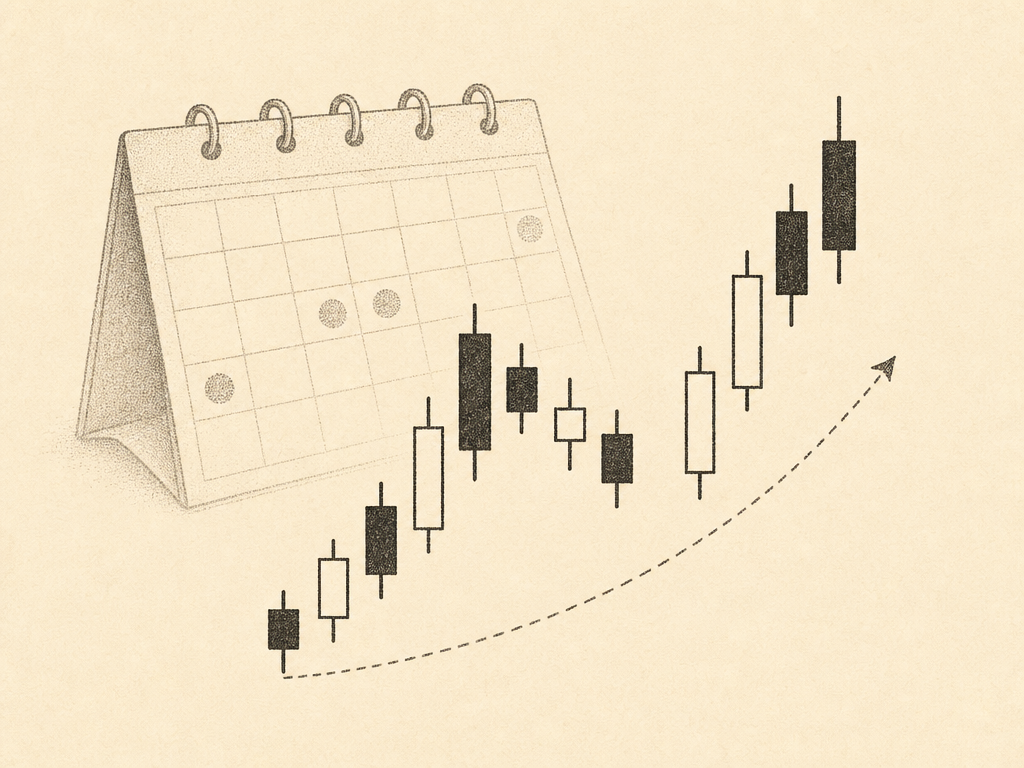
A swing trade is a position held for a few days to a few weeks, built to capture one “swing” of a stock’s price movement — one up-leg in an uptrend, or one recovery after a pullback. That is the general definition and it is the one to expect as a starting point. Mine are an exception that I describe later: I hold them four to eight weeks and I express them as monthly options, calls and puts, so every position carries its own expiry date. The style sits in the middle ground between day trading, which ends every day flat, and investing, which holds for years and shrugs at the wiggles. The swing trader cares about the wiggles. That is the whole job.
Key Takeaways
- A swing trade runs a few days to a few weeks — a common textbook range is two to ten trading days.
- Mine are longer, four to eight weeks, because I express them as monthly options. That is my own extension, not the style's rule.
- The daily chart is the working timeframe; the weekly sets context.
- Swing trading is not day trading — no screens glued all session.
- It is not investing — the position expires with the month instead of being held on.
- The edge comes from selection and patience, not screen time.
How long is a swing trade held?
Start with the norm. A swing trade is conventionally held a few days to a few weeks, and a common textbook range is two to ten trading days. Hold any longer than that and you are drifting toward a position trade. Nobody who is starting out needs to sit on a trade for weeks — that is not the standard and it is not a requirement of the style.
My own trades run four to eight weeks, and that is my choice rather than the rule. The reason is the instrument. I use monthly options, calls and puts, because a fixed amount of buying power behind a position then covers more underlying stock and stays productive instead of sitting idle. That is also what sets the clock: the capital behind a position is committed against margin for at least a month, so the position is designed to use the month it has paid for. The multi-week holding period follows from the instrument and the signal behind the entry — it is a property of the contract I trade, not a requirement of swing trading, and the cost is real. Capital stays locked for weeks while other opportunities pass me by.
Weekly options do exist on the larger tickers. I looked at them and skipped them. For the same amount at risk over the same operating process, the premium is smaller, and the shorter life would force me to watch the market far more tightly than I want to. In both cases the holding period is chosen, not endured: the position ends when the reason for holding it is gone, and with a monthly option the expiry is simply the clock that enforces it.
Which timeframes matter
One chart for decisions, one for context:
- Daily — where entries and targets are set.
- Weekly — where the bigger trend is judged. A perfect daily setup inside a broken weekly trend is a warning, not a green light.
I seldom use intraday charts. The temptation is to check a five-minute bar to see whether the day is going my way. With tens of tickers on the list, that turns into a full-time job of watching noise. The daily and weekly charts already tell me the two things I actually need: where the trend is, and whether the setup is worth taking.
How it differs from day trading
Day trading closes positions before the session ends; the day trader’s risk is measured in hours. The swing trader accepts overnight risk — gaps, news, the market opening against you — in exchange for not needing to watch every tick. The cost of that choice is real, and it is why position sizing (a fixed small risk per trade) is non-negotiable. The benefit is a process that fits around a business and a life, which is the only reason I can do this at all.
How it differs from investing
The investor’s question is “is this a good company to own for years?” The swing trader’s question is “is this a good trade right now, with an exit attached?” A swing trade in a weak company can be perfectly sound; an investment without an exit is how swing accounts quietly turn into unintended portfolios. The discipline that separates the two is writing the exit down before entry.
Who swing trading suits
It suits people who can check the market briefly once a day, make decisions calmly in advance, and accept that most days the correct action is none. It does not suit anyone who needs constant action — the strategy will bore them into mistakes.
Questions about swing trading
How much money do I need to start swing trading?
The mechanics work at small size — nothing in the process itself demands a large account. The real risk is not the account minimum, it is impatience. A small account does come with weaker liquidity, and while capital is locked in a position I sit through opportunity windows I cannot take. So the smaller the account, the fewer tickers I would trade, to stay as liquid as the account allows.
Can I swing trade while working full-time?
Yes — it is the style built for that. Decisions are made from the daily chart after the close or before the open, not during the session.
What percentage of swing trades win?
A high win rate on its own means nothing. What matters is the size of the wins against the size of the losses, and whether I keep winning more than I lose often enough to stay in this business month after month. My own monthly rate has been 70% on average so far. That is a record of my own trading, not a forecast, and it says nothing about what anyone else's account will do. For me, a win rate over 55% is the line for staying in the trading business week after week — below that, I had better quit and do something more productive.
Educational notes on my own process, not investment advice. Trading involves risk of loss.